

The long President’s Day weekend is officially in the rearview mirror, and we are now staring down the final stretch of the first quarter of 2026. The new year energy has settled into the daily grind, the rain is keeping the hills green, and the businesses down in the Arsenal and along First Street are fully engaged in executing their goals for the year. Patchwork tech, IT costs, and business technology ROI.
Securing Your Small Business IT Infrastructure Against Modern Threats
When you rely on a fragmented network, you are often trusting the outdated myth of security through obscurity—believing that cybercriminals will simply overlook your company because you are small. Unfortunately, hackers actively target vulnerable small business IT infrastructure because they know patchwork systems lack enterprise-grade monitoring, regular patch management, and unified threat detection. A single compromised consumer router or an unpatched legacy desktop can provide an open backdoor straight into your most sensitive financial and customer data.
But let’s do a quick reality check on those goals. As a local business owner, your greatest superpower is likely your resourcefulness. When a problem arises, you figure out a way to solve it. You roll up your sleeves, you get scrappy, and you “make do.”
While that mindset is fantastic for entrepreneurship, it is absolutely disastrous for your business technology.
When applied to your IT infrastructure, “making do” inevitably leads to a patchwork system held together by digital duct tape. And while it might feel like you are saving money in the short term, this Frankenstein approach is quietly draining your time, your budget, and your team’s momentum.
Here is why relying on patchwork technology is the most expensive mistake you can make this quarter, and how to fix it before Q2 begins.
Patchwork tech: 1. The “Frankenstein” Infrastructure
We see this all the time: a business network pieced together over five years based on whatever was on sale at the moment. You have one employee on a five-year-old PC, another on a brand-new Mac, a consumer-grade Wi-Fi router bought from a big-box store, and files scattered between personal Dropboxes and local hard drives.
The Reality: This isn’t a network; it’s a liability. Consumer-grade hardware is not designed to handle the secure data loads of a modern business. Furthermore, when these mismatched systems inevitably fail to communicate with each other, it takes hours of troubleshooting to find the weak link.
The Fix: Standardization. Moving your team to a unified, business-grade ecosystem (like Microsoft 365 or Google Workspace) with standardized hardware ensures everyone is playing by the same rules, using the same tools, and protected by the same security protocols.
2. The Silent Payroll Drain
Have you ever calculated the cost of a slow computer?
Let’s say an employee makes $30 an hour. Because they are using an aging laptop, they spend 15 minutes a day waiting for it to boot up, unfreeze, or load large files. That is 1.25 hours a week, or roughly 65 hours a year.
The Reality: You are paying that employee almost $2,000 a year simply to stare at a loading screen. Now multiply that by your entire staff. The money you “saved” by not buying a new $1,200 laptop has actually cost you double in lost productivity. Patchwork tech creates daily micro-frustrations that kill your team’s momentum and morale.
The Fix: Implement a hardware lifecycle policy. Computers should be replaced every 3 to 5 years, proactively, before they break down and start costing you payroll hours.
3. The “Security by Obscurity” Myth
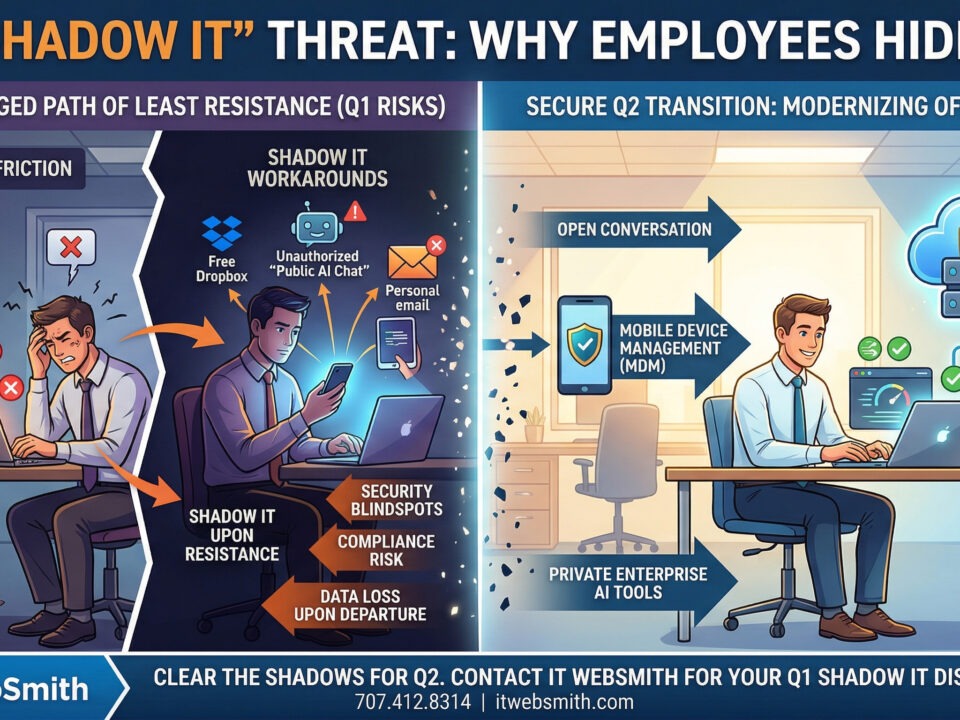
When your tech is pieced together, your security is full of holes. Many small business owners rely on the “Security by Obscurity” myth—the belief that because they are just a small shop in Benicia, hackers won’t bother targeting them.
The Reality: Cybercriminals in 2026 don’t sit at a desk manually targeting you. They use automated bots that scan the internet 24/7, looking for easy targets. They don’t care who you are; they care that your patchwork Wi-Fi router has an outdated firmware vulnerability they can exploit in seconds.
The Fix: Stop relying on free antivirus software. You need a centralized, Managed Cybersecurity strategy that actively monitors your network, automatically patches vulnerabilities, and utilizes strict Multi-Factor Authentication (MFA) across the board.
4. Your Website as an Afterthought
Patchwork tech doesn’t just happen in the office; it happens online, too. If your website is a random collection of outdated plugins, broken links, and design elements from 2020, it is actively turning customers away. In a year where seamless digital experiences are the baseline expectation, a clunky website tells potential clients that your business might be clunky, too.
Stop Making Do, Start Moving Forward
You have worked too hard to build your business to let a bad internet connection or a dying hard drive hold you back. As we approach the end of Q1, give yourself permission to stop playing the role of the “IT Fixer.”
At IT WebSmith, we help Benicia businesses replace the digital duct tape with rock-solid, proactive, and managed technology solutions.
Would you like me to schedule a Q1 “Tech Reality Check” audit for your business to identify exactly where your current systems are costing you time and money?
Ready to take action? Explore our web development and IT services to help your business succeed. For more information, visit IT WebSmith or check out the NIST Cybersecurity Framework for expert guidance.